

The Global Organic Textile Standard (GOTS) Demystified
GOTS is the world’s leading processing standard for textiles made with organic fibers, setting strict environmental and social criteria across the entire supply chain—from raw material harvesting to final labeling. It requires third-party verification to ensure textiles are produced sustainably and ethically. A product must contain a minimum of 70% certified organic fibers to be GOTS labeled, or 95% to be labeled as 'Organic' status.
The GOTS Certification Journey
Step 1: Inform & Plan
Familiarize yourself with the current GOTS Standard (Version 7.0) and all mandatory requirements. Ensure your products meet the minimum organic fiber content (70% or 95% minimum) and assess your supply chain for compliance.
Step 2: Engage a Certifier
Select an independent, third-party GOTS-approved Certification Body (CB). This CB will be responsible for conducting all audits, inspections, and issuing certificates.
Step 3: Apply & Document
Submit a formal application to the CB, providing comprehensive documentation on your facility's operations, product scope, and the management systems you have in place to ensure ongoing GOTS compliance.
Step 4: Annual Audit & Inspection
The CB conducts an annual on-site audit (or remote inspection for some traders). This includes reviewing mass balance data, checking chemical inputs, inspecting wastewater treatment, and verifying social compliance via worker interviews and documentation.
Step 5: Receive Scope Certificate
Upon successful compliance, the CB issues a Scope Certificate (SC). This public document confirms that your company is certified and is allowed to process, manufacture, and sell GOTS-certified goods.
GOTS certified organic cotton(Cite: Selfless Clothes)
Core Pillars of the GOTS Standard
Environmental Criteria
Protecting the planet from raw fiber to finish
The environmental requirements are strict, following a "No hazard in, no hazard out!" principle, which controls inputs throughout the entire wet-processing chain to minimize impact:
ØChemical Management: Prohibits a wide range of toxic substances, including heavy metals, formaldehyde, aromatic solvents, and functional nanoparticles. Only GOTS-approved colorants and auxiliaries are permitted.
ØBleaching & Dyeing: Chlorine bleaching and azo dyes that release carcinogenic amines are strictly banned. Only oxygen-based bleaches (like hydrogen peroxide) are allowed.
ØWastewater Treatment: A functional wastewater treatment plant is mandatory for all wet-processing units to treat effluent before discharge.
ØPackaging: All packaging material must not contain PVC. Paper and cardboard used (including hang tags) must be recycled or certified (FSC/PEFC).
Social & Ethical Criteria
Compliance with International Labour Organization (ILO) norms
GOTS mandates that all processors and manufacturers adhere to key ILO conventions. This ensures that a product is not only ecologically sound but also ethically made:
ØSafe Conditions: Working environments must be safe and hygienic, minimizing risk of accident or injury.•No Forced or Child Labour: Employment must be freely chosen, and child labour is strictly prohibited in all forms.
ØFair Wages: Remuneration must meet national legal or industry benchmark standards, whichever is higher, and a living wage gap assessment must be performed.
ØWorking Hours: Working hours must not be excessive, with mandated rest periods and restrictions on forced overtime.
ØFreedom of Association: The rights to collective bargaining and freedom of association must be respected, allowing workers to form or join unions.
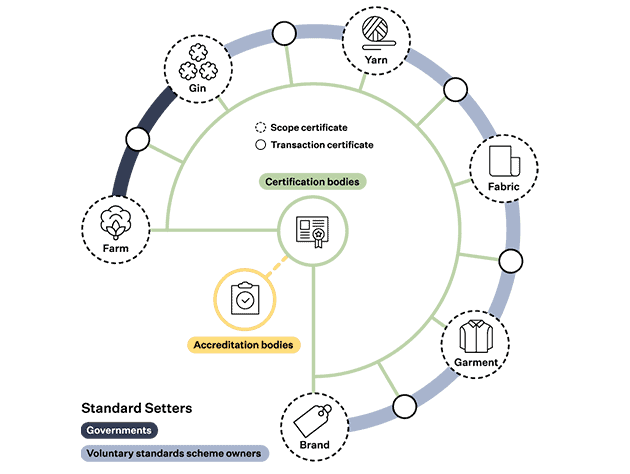
Organic cotton certification(Cite: Textile Exchange)
Traceability and Assurance: Scope and Transaction Certificates
GOTS achieves its industry-leading transparency through a rigorous dual-certification system:
1. Scope Certificate (SC): Certifies the company (processor, manufacturer, or trader) and the specific GOTS activities they are approved to conduct.
2. Transaction Certificate (TC): This is the crucial document for traceability. A TC is issued for every single shipment of GOTS goods sold between certified entities. It details the product type, quantity, buyer/seller information, and verifies that the materials maintain GOTS integrity from one stage to the next. This ensures an unbroken, verifiable chain from the organic farm to the finished textile.
#How to get GOTS certified for textiles, #GOTS environmental and social criteria, #GOTS scope certificate vs transaction certificate, #Sustainable apparel manufacturing standards, #Organic cotton supply chain traceability